Tally

The paper behind the audit

Every figure on this page came off somebody's paper.

First, how a finding points at the exact field on a signed ticket. Then six real records, names taken out, arithmetic left in.

A finding points at a field, and we draw the box

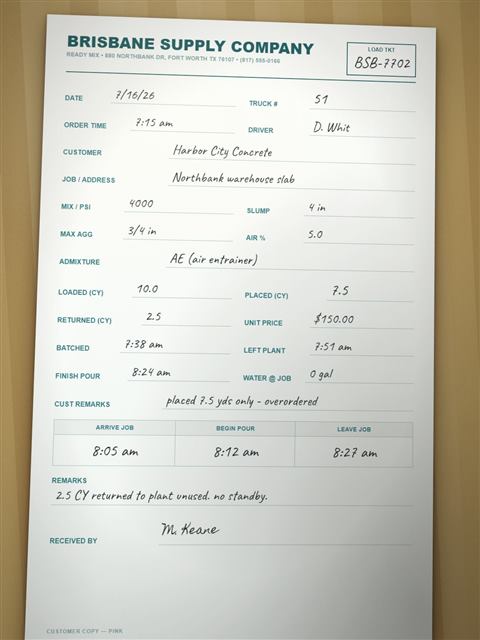
Every dispute package carries the tickets it cites, and on each one the fields behind the findings are boxed. Your rep sees the number, then the paper that number came off, without hunting for it.

Sample signed delivery ticket BSB-7702 from the fictional Brisbane Supply Company. Two orange highlight boxes are drawn on it: one around the load ticket number at the top right, one around the unit price of $150.00 in the middle of the ticket.
Highlighted: the signed ticket fields these findings cite.
Sample document

What the boxes mark

  • Load ticket number BSB-7702. The duplicate check reads this number off every ticket and looks for it on every invoice in the month, not one invoice at a time. Detail 1, enlarged. The number the duplicate check carries across the month.
  • Unit price $150.00. The rate check compares the printed price against your quote or contract rate for that job, in the rounding your supplier already uses. Detail 2, enlarged. The price the rate check reads off the signed ticket.

This ticket is a fixture: a document we generated for a fictional supplier so we could test the audit against known answers. It is not a customer's paperwork and it is not a public record. The six specimens below are the opposite: real public records, printed here as figures and never as images.

Suppliers correct these too, once they see their own paper

None of this is about a supplier trying to shortchange anyone. Most billing errors are exactly that: errors, the ordinary kind that turn up across tens of thousands of invoice lines a month.

The specimen that leads the next section is a supplier correcting its own invoice, on its own initiative, once the paper laid out the arithmetic plainly. Our job is making sure the number everyone ends up arguing about is the real one, checked before it's paid instead of disputed after.

Every specimen below is from a public record. Names withheld, figures exact. Citations available on request.

Six specimens, four error families

Real paper, no images: names withheld, dollar figures and arithmetic exact to the cent. Each specimen leads with its number, then says what the document shows, what it proves, and which error family in the audit catches it.

Exhibit A · the process working

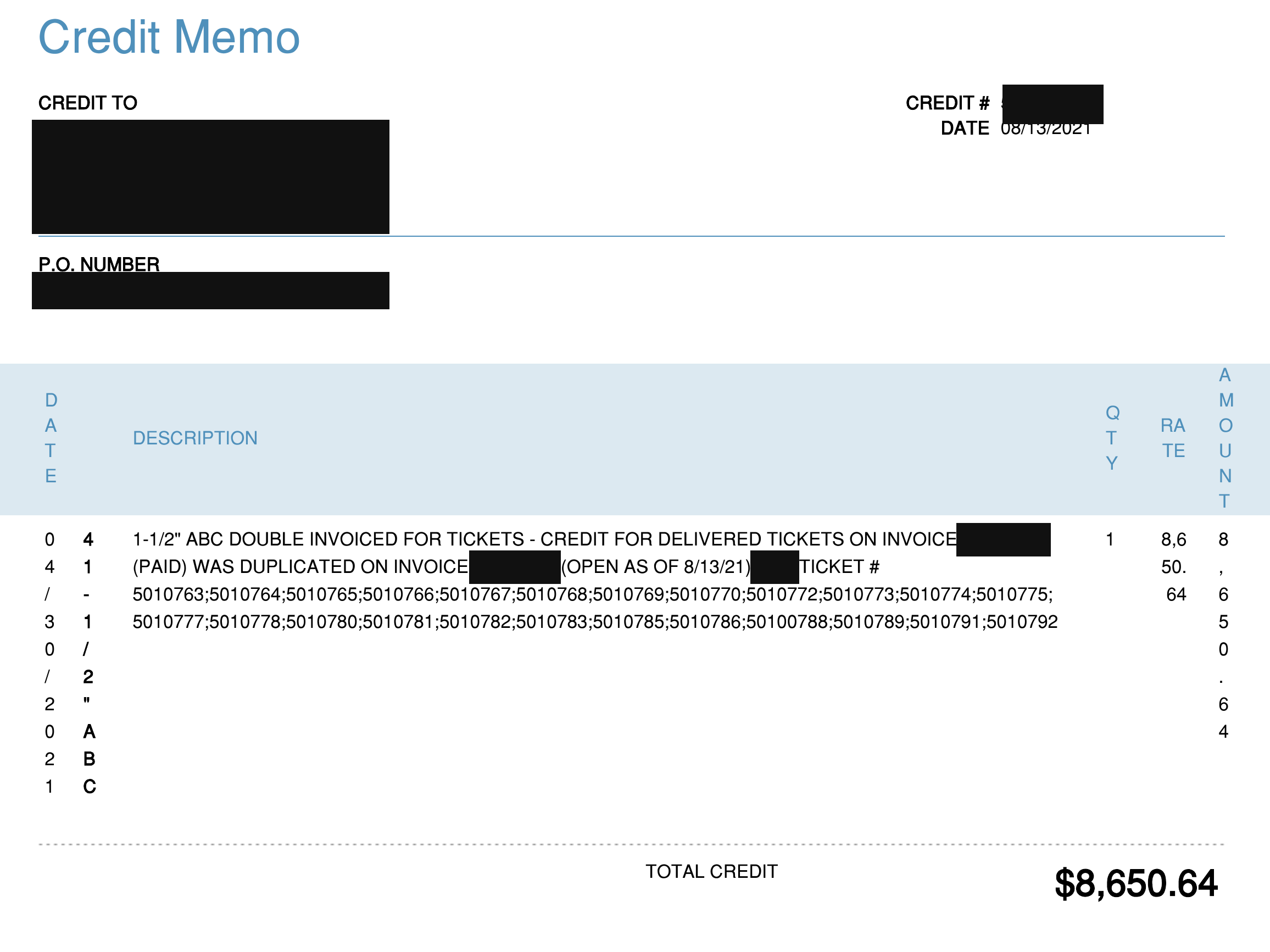
−$8,650.64Credited on the supplier's own memo, 24 tickets

A supplier's own credit memo confesses a double bill

What the paper shows

The memo's own line states, in the supplier's words, that tickets already delivered and paid on one invoice were duplicated onto a second invoice that was still open. The supplier found its own mistake and corrected it before anyone else raised it.

What it proves

The same delivery ticket really can get billed twice, across two invoices, at real dollar amounts. This is the cross-invoice check TallySquared runs on every month's stack: every ticket number read across every invoice.

Error family: Duplicate billing
Exhibit B

$189.75Rate correction on one job

The credit memo that decodes its own overbill

What the paper shows

Eight invoices summing $14,689.49, minus a credit memo for $189.75, netting $14,499.74. The memo does the arithmetic in the open: 16.5 CY × $11.50 = $189.75, the exact gap between the job's $75.00 rate and the $86.50 that invoice billed on that same 16.5 CY.

What it proves

One mispriced line, reversed to the penny. That is the shape of a rate error: every line checked against the job's actual rate, and no claim ever larger than that line's own arithmetic supports.

Error family: Rate errors
Exhibit C

$133.60Printed from $133.595 on one invoice

The same supplier, two different rounding rules

What the paper shows

Four lines only balance under one rounding rule: 24.290 × $5.50 = $133.595, printed as $133.60; 24.290 × $4.50 = $109.305, printed as $109.30. Both rule out plain round-up and plain truncation, and both fit round-half-even. Invoices from that same supplier a couple of years later use ordinary round-up instead.

What it proves

A supplier's rounding convention can change over time, and a check built on one fixed rule will misflag paper that was never wrong. We account for how each supplier rounded in the era an invoice was printed before calling a line incorrect.

Error family: Rate errors
Exhibit D

$254.60Billed alone, then again inside a group

Two tickets, billed once alone and once inside a bigger group

What the paper shows

Two delivery tickets billed by themselves on one invoice: 29.83 tons × $8.00 = $238.64 plus $15.96 tax, $254.60 total. Those same two ticket numbers also appear inside an eight-ticket group on a second invoice, filed the next day, same purchase order, same delivery date. No credit memo corrects it, and both invoices balance perfectly on their own.

What it proves

A total can add up exactly and still hide a load counted twice. Catching it takes a ticket-by-ticket check across every invoice in the stack, the same check Exhibit A shows a supplier running on itself.

Error family: Duplicate billing
Exhibit E

$0.00 / $5.00 / $0.00Same job, same season, same fee line

A fee that turns on and off mid-job, tied to the order, not the date

What the paper shows

One job's fuel surcharge line prints $0.00 across a run of deliveries, then $5.00 across the next run, then $0.00 again. The fee doesn't move with the calendar or the customer's account; it moves with which order each delivery was placed under.

What it proves

A fee can be legitimately absent on one delivery and legitimately present on the next from the same supplier the same week. We check each fee against the terms attached to its own order.

Error family: Unauthorized and mis-applied fees
Exhibit F

54 / 52Ticket lines billed / tickets in the file

Fifty-four ticket lines billed, fifty-two tickets in the file

What the paper shows

One invoice set bills 54 ticket lines across a month of deliveries. Counting every ticket in the supporting file against that billed list finds only 52 tickets there; two billed ticket numbers never appear anywhere in the file. Every dollar total in the set still reconciles exactly.

What it proves

A perfect-looking total doesn't mean every line traces to paper. The gap only surfaces when every invoice line is checked against a signed ticket, one by one, which is what ticket coverage means here: a line with no ticket behind it gets flagged instead of quietly paid.

Error family: Coverage

The worked-example package

Every audit that finds something ships as a dispute package: the disputed line, the ticket it traces to with the field boxed, the rate or term it breaks, ready to send to a supplier.

Worked-example package

A TallySquared-branded edition built around one of the specimens on this page, arithmetic laid out in full, ships with the site cutover. Until then we're not linking the old-branded sample here: shipping this brand's name on last year's document would be its own kind of error.

Worked-example package: available at launch

Meanwhile, see a sample dispute package for the package structure itself.

First audit free

Send us last month's full stack: every invoice, every signed ticket. We check every line and send back what doesn't hold up. No cost for your first month.