Will disputing invoices damage my supplier relationship?
No. You're not accusing anyone, you're reconciling. Every finding is a line item matched to a signed delivery ticket, which is exactly the documentation a supplier's billing department needs to issue a credit. Reps handle documented disputes routinely. What damages relationships is disputing vaguely or withholding payment without evidence. This is the opposite.
How quickly will I see results?
Minutes. Send last month's invoices and signed tickets, and the report comes back with the exact line and the ticket behind it for anything that doesn't match.
What does the free audit include?
Last month's full stack, free: every invoice, every signed ticket, and your rate sheet or quote if you have one. We check every line, total it, and package it into a dispute-ready PDF with the evidence your rep needs to issue a credit. If the month reconciles clean, the next month back unlocks free, up to three. See exactly what you get: a full sample audit.
Do I need purchase orders or accounting software for this to work?
No. Most billing-check tools in construction are built around purchase-order matching and need your accounting system connected before they verify anything. TallySquared needs only the paper you already have. Keep Procore, Foundation, or Sage. Nothing gets replaced or connected, phone photos are enough to start, and the pricing is on this page rather than behind a sales call.
Is this a three-way match?
No. Three-way matching needs a PO system. We prove the invoice against the supplier's own signed delivery paper, so there is nothing to install and nothing to integrate.
What if you don't find any overcharges?
You owe us nothing, and you get two things: written proof the month reconciles, line by line against your signed tickets, and your next month unlocked free. Billing errors are episodic, so one clean month isn't the same as a clean quarter. We keep looking on our dime.
How accurate are the findings?
Every finding is labeled confirmed or flagged for review. Confirmed means your own signed ticket, rate agreement, or the invoice's own terms prove it, with the exact dollar amount shown. Flagged means something looks off but the documentation is incomplete, and we tell you what's missing. We never pad a package with maybes.
Is my data secure? Who sees my contracts?
Your documents are encrypted in transit and at rest, used only to run your audits, and never shared with suppliers or anyone else. Your rate agreement stays yours. Delete your account and your documents are deleted with it.
How do I get my delivery tickets to you?
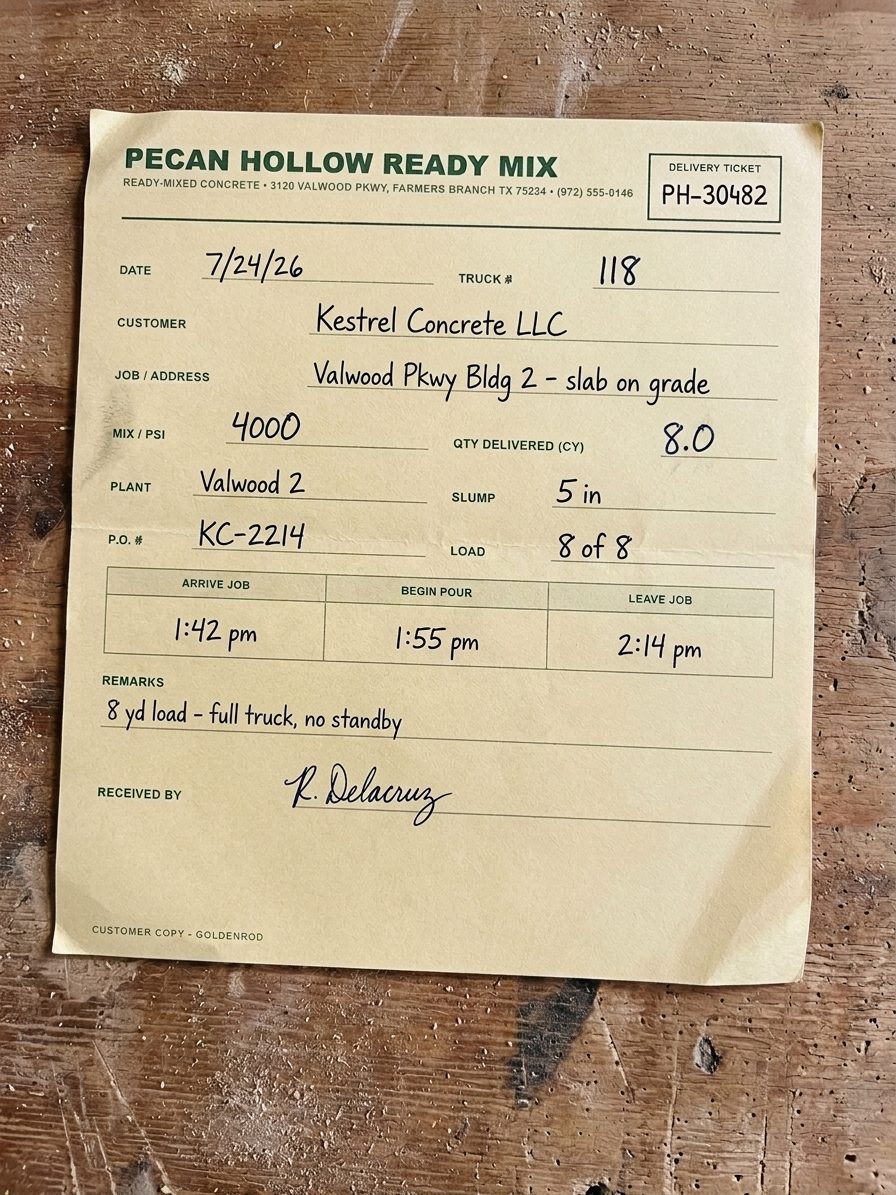
Phone photos work fine. Scans work too. Even crumpled carbon copies from the job site. Upload them directly through the platform.
What if I go over my delivery limit?
If you hit your limit we'll reach out before your next billing cycle with an upgrade option. You'll never lose access to your results or get cut off mid-month.